On a rural sale, the septic system is one of the few things that can hold up a closing. Most of the time it doesn't have to. The buyer wants to know what's in the ground, the seller wants a clean report, and the agents want a date that holds. This is how that works in Washington, including a rule change that starts February 1, 2027.
What Washington requires at a sale today
Washington's septic rule (WAC 246-272A-0270) already puts two duties on a seller at the time of transfer:
- Hand over the records. The seller provides the buyer with all available maintenance and repair records for the septic system.
- Complete the seller disclosure statement. Washington's disclosure form for residential property (RCW 64.06.020) has a full section on sewer and on-site sewage systems. More on what it asks below.
The same rule requires routine inspections for as long as anyone owns the house: at least every three years for a system that's only a septic tank and a gravity drainfield, and every year for all other systems. A seller who has kept up with those inspections has most of the paperwork a buyer will ask for.
What changes on February 1, 2027
Starting February 1, 2027, Washington's rule adds an inspection at the time of property transfer. The seller obtains an inspection of the septic system by a third-party inspector authorized by the local health department, and the results go to the local health department on its approved form.
The rule gives the local health department room to adjust:
- It can remove the transfer inspection requirement if it has evidence the system is current on its routine inspections and was inspected by an authorized third-party inspector.
- It can verify the results of the inspection.
- It can require more, including inspections or requirements beyond the state's list.
- It can set a compliance schedule to repair a failure found during the transfer inspection.
If you're listing a house on septic in 2027, ask your county health department how it will handle the transfer inspection. In Walla Walla County, that's the Department of Community Health at 509-524-2650.
What the seller disclosure asks about septic
If the property is on an on-site sewage system, Washington's disclosure statement asks the seller:
- Was a permit issued for its construction, and was it approved by the local health department after construction?
- When was it last pumped?
- Are there any defects in its operation?
- When was it last inspected, and by whom?
- How many bedrooms was the system approved for?
- Are all plumbing fixtures, including the laundry drain, connected to the system?
- Have there been any changes or repairs to the system?
- Is the system, including the drainfield, located entirely within the property boundaries?
- Does the system require monitoring and maintenance services more often than once a year?
Buyers should read these answers closely. Sellers who can't answer them should find out before listing.
What a septic inspection covers
EPA describes what a typical septic inspection involves. A thorough one includes:
- Reviewing the permit, design and installation records, including the system's age
- Reviewing pumping and maintenance records
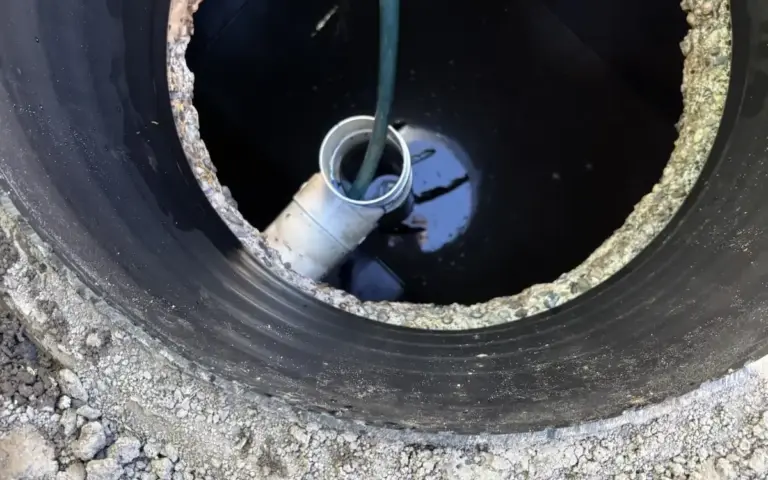
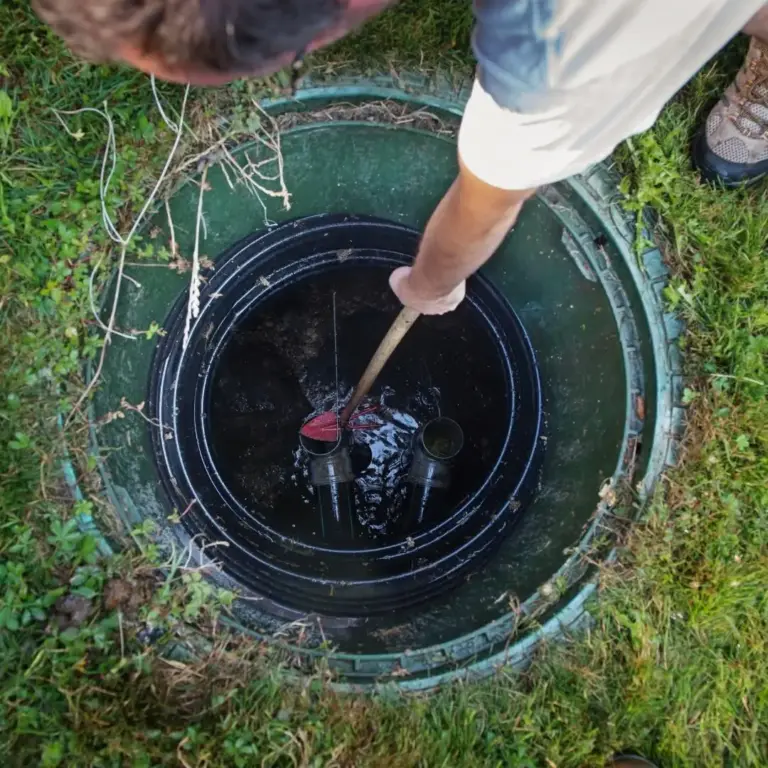
- Opening and inspecting the tanks: the septic tank, any pump tank and the distribution box
- Measuring sludge and scum and deciding whether the tank needs pumping
- Checking the effluent filter, if there is one
- Looking for leaks, such as low water levels in the tank
- Looking for signs of backup, such as staining above the outlet pipe
- Checking the tank, inlet and outlet pipes for damage and corrosion
- Checking electrical connections, pumps, controls and wiring
- Evaluating the drainfield for standing water or surfacing sewage
Our inspections are lid-off, with photos and a written report. Most include a pump-out, because you can't see the tank walls or baffles through a full tank. We tell you up front if yours doesn't need one.
A timeline that keeps septic off the critical path
As soon as there's a purchase agreement: book it
Book about two weeks before closing. That leaves room for a buried lid, bad weather or a repair. When you book, give us the closing date and the list of who gets the report.
Before the visit: gather records and find the lid
Pull together the pumping and inspection receipts and the county's record drawing, if there is one. In Walla Walla County, the Department of Community Health has location diagrams for septic systems. If the lid is buried, we locate it and dig it out, and a riser makes the next visit faster. See How to find your septic tank lid.
The visit: pump-out and inspection
Most visits start with a pump-out so the walls and baffles can be seen. Then we inspect every component we can reach and photograph it.
After the visit: the report
The written report usually goes out within two business days, to everyone on the list: typically the buyer, the seller, both agents and the lender.
For buyers
Ask for the septic records, read the seller's disclosure answers, and check a few things against the house in front of you:
- Bedrooms. The disclosure asks how many bedrooms the system was approved for. If the house has more now, ask about it.
- Age and records. A system with no pumping or inspection records is an unknown, not a bad system. The inspection turns it into a known.
- Pumps and alarms. Systems with pumps or treatment units have to be inspected every year under Washington's rule. Budget for it.
- Where the drainfield is. The disclosure asks whether the system sits entirely within the property. Find out before you plan a shop, a pool or a garden.
Who pays for the inspection is set in the purchase agreement. In our area the seller often pays, but it varies, and your agent will know.
For sellers
The cleanest septic sale is one where the seller already has the answers.
- Gather every pumping and inspection receipt you can find.
- Ask the county for the record drawing.
- Answer the disclosure questions accurately. If you don't know when the tank was last pumped, find out.
- If the lid is buried, have it found and consider a riser. It saves digging at the inspection and at every visit after.
- From February 1, 2027, plan for the transfer inspection the state rule requires, and ask the county how it will apply to your system.
For agents
Septic goes smoothly when it starts early. Book the inspection when the purchase agreement is signed, give us the closing date and the report list, and tell your sellers about the 2027 transfer inspection now. Our closings page has the planner that works backward from your closing date.
If the inspection finds a problem
Most findings fall into a few categories. Washington's Department of Health lists the common ones: a clogged pipe from the house to the tank, a blocked inlet baffle, a clogged outlet baffle or effluent filter, and a drainfield that has failed or is saturated. The Department of Health calls the first two easy, low-cost fixes in many cases. A clogged outlet baffle or filter usually means cleaning the filter or pumping the tank. A failed drainfield is the big one.
Repairs to a septic system need approval from the local health department before the work starts, under Washington's rule. Every repair we do is quoted on site, in writing, before any digging starts, and we run our own excavator, so a repair doesn't wait on a second contractor to bid it.
If money is the obstacle, Washington's Department of Health points to a few options: Craft3, a nonprofit lender that offers loans in several counties; low-interest loan and grant programs at some local health departments; and USDA home repair programs for those who qualify.
Have a closing date?
Book the inspection with your closing date and the report list. We schedule backward from it.