
Most household septic tanks are pumped every three to five years. That's the range the U.S. Environmental Protection Agency and Washington's Department of Health both give. But an average doesn't pump a tank. Two people on a 1,500 gallon tank and a family of six on 1,000 gallons are nowhere near the same schedule, and the chart below shows how far apart they are.
The short answer
- The typical range is three to five years. EPA says household septic tanks "are typically pumped every three to five years," and Washington's Department of Health says the same for a typical household.
- Your number depends on four things: how many people live in the house, how much water goes down the drain, how many solids go in with it, and the size of the tank.
- Washington also requires inspections. A system that's only a septic tank and a gravity drainfield has to be inspected at least once every three years. Every other type of system has to be inspected every year.
- The inspection tells you whether it's time. A septic professional measures the sludge on the bottom and the scum on top. Those two numbers decide when the tank gets pumped.
Why a septic tank needs pumping at all
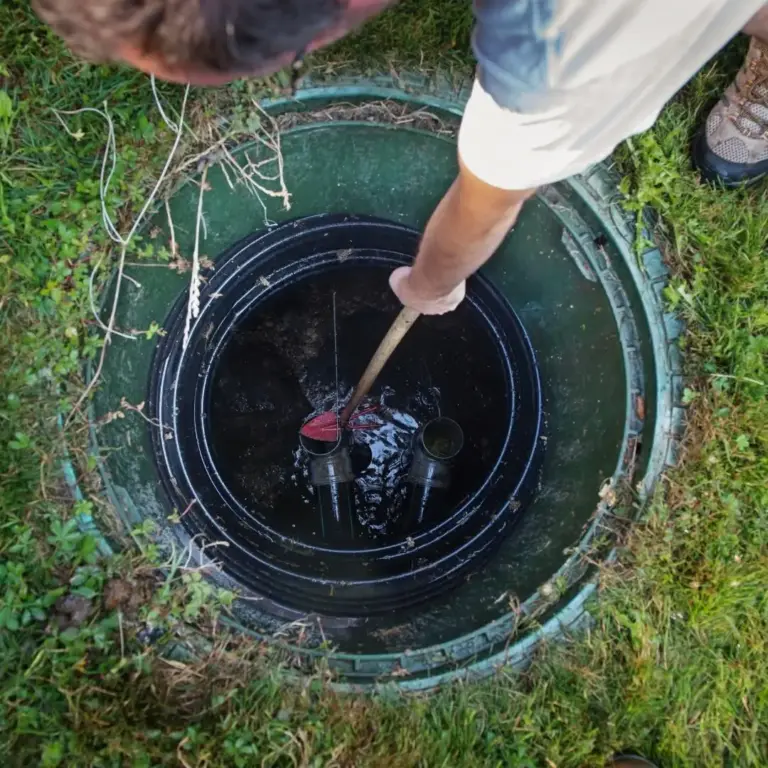
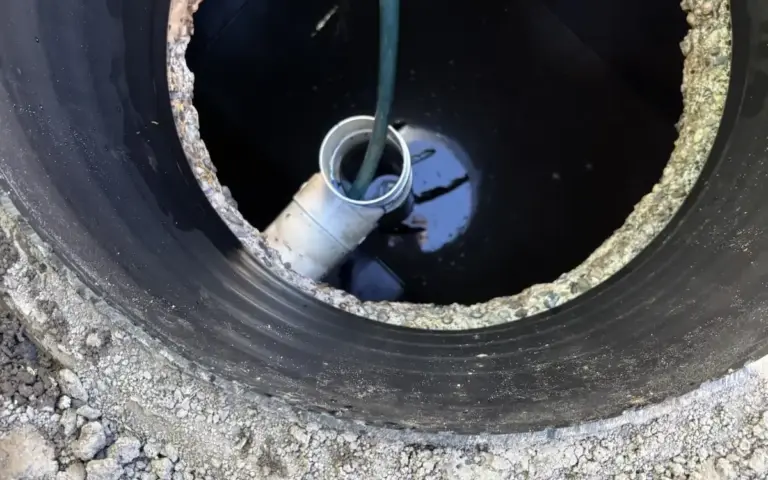
A septic tank is a settling tank. Wastewater from the house flows in, and the heavy solids sink to the bottom as sludge while grease and lighter material float to the top as scum. The clearer liquid in the middle flows out to the drainfield, where the soil finishes the treatment.
Bacteria in the tank break down some of those solids, but not all of them. Oregon State University Extension puts it at up to half. The rest builds up, year after year, until the sludge and scum crowd the liquid layer. Then the tank stops having time to settle, and solids start riding out with the liquid into the drainfield pipes and soil.
That's the failure pumping prevents. Penn State Extension estimates that each adult adds about 60 gallons of solids to a septic tank every year, and that sludge and scum should never fill more than about 30 percent of the tank. Do that math on a 1,000 gallon tank and one adult fills the working space in about five years. A family of four does it in about a year and a half.
Septic tank pumping frequency chart
This is the chart our Pump Check tool uses. It comes from Oregon State University Extension's guide to septic tank maintenance (publication EC 1343), and it estimates years between pumpings for a home lived in year-round.
| Tank size | 1 person | 2 people | 3 people | 4 people | 5 people | 6 people |
|---|---|---|---|---|---|---|
| 750 gallons | 9.1 years | 4.2 years | 2.6 years | 1.8 years | 1.3 years | 1.0 year |
| 1,000 gallons | 12.4 years | 5.9 years | 3.7 years | 2.6 years | 2.0 years | 1.5 years |
| 1,250 gallons | 15.6 years | 7.5 years | 4.8 years | 3.4 years | 2.6 years | 2.0 years |
| 1,500 gallons | 18.9 years | 9.1 years | 5.9 years | 4.2 years | 3.3 years | 2.6 years |
| 2,000 gallons | 25.4 years | 12.4 years | 8.0 years | 5.9 years | 4.5 years | 3.7 years |
How to read it
Find your tank size on the left and your household across the top. A family of four on a 1,000 gallon tank lands at about 2.6 years. Two people on a 1,500 gallon tank land at about 9 years.
Two cautions. First, the chart is an estimate for year-round homes. Oregon State notes that tanks need pumping more often when the household uses a garbage disposal. Second, a long number on the chart doesn't change the inspection schedule. A gravity system in Washington still gets inspected at least every three years, even if the chart says the tank could go nine.
If you don't know your tank size
Start with the paperwork. The county may have a record drawing of your system, and a past pumping receipt often lists the gallons. In Walla Walla County, the Department of Community Health keeps location diagrams for septic systems (509-524-2650). If there's no record, the person who pumps the tank can tell you what they found.
What changes your number
EPA and Washington's Department of Health name the same four factors. Here's what each one means in a real house.
How many people live there
More people means more solids and more water. The chart shows how fast it adds up: on a 1,000 gallon tank, going from two people to four cuts the estimate from about 5.9 years to about 2.6. Kids in the house, tenants in a shop apartment, or a long stretch of house guests all count.
How much water goes down the drain
Water doesn't add sludge, but it rushes the tank. When too much arrives at once, the tank can't settle completely, and Washington's Department of Health notes you may need to pump more often. EPA puts average indoor use as high as 70 gallons per person per day, and says a single leaky or running toilet can add as much as 200 gallons a day. EPA also recommends spreading laundry across the week instead of doing it all in one day.
How many solids go in
A garbage disposal is the big one. EPA says that if you use a disposal, your tank will need to be pumped more often, and both EPA and Oregon State recommend limiting or skipping it on a septic system. Washington's Department of Health adds RV and boat waste dumped into the system to the list. Penn State Extension adds that things that don't break down at all, like cat litter and plastics, fill a tank quickly.
The size of the tank
A bigger tank holds more before it needs attention. The catch is older homes. Washington's Department of Health points out that older tanks may not be sized for the house anymore, especially after a remodel that added bedrooms.
How a septic professional decides it's time
You don't have to guess. EPA gives the measurements: a tank should be pumped when the bottom of the scum layer is within six inches of the bottom of the outlet, when the top of the sludge layer is within 12 inches of the outlet, or when sludge and scum together take up more than 25 percent of the liquid depth.
That's why the numbers matter more than the date. Every pump-out we do includes measuring the sludge and scum, so you know how fast your tank actually fills, and you get your next due date in writing. EPA recommends writing those levels down after every service so you can see the trend.
What Washington requires
Washington's septic rules (WAC 246-272A-0270) put maintenance on the owner. Two parts matter here:
- Inspections. A system made up only of a septic tank and a gravity drainfield must be inspected at least once every three years. All other systems, including ones with pumps or treatment units, must be inspected every year. The local health department can require more.
- Pumping when it's needed. The rule ties pumping to the tank itself: pump when the level of solids and scum shows it's time.
Walla Walla County's septic page says it simply: pump and inspect a gravity system every three to five years, and inspect all other types once a year.
Signs you've waited too long
If you're seeing any of these, don't wait for the date on the chart:
- Drains slowing down all over the house
- Gurgling in the plumbing
- Sewage odors near the tank or drainfield
- Wet, soggy ground or standing water over the tank or drainfield
- Bright green, spongy grass over the drainfield, even in dry weather
- Water backing up into the lowest drains
We cover each one in Signs your septic tank is full.
Why waiting for a backup costs more
A backup feels like the moment the tank got full. Usually the damage started earlier. Penn State Extension explains that by the time sewage backs up into a home, the soil under the drainfield is often clogged with a nearly impermeable layer called a biomat, and pumping the tank won't remove it.
Washington's Department of Health frames the money side: maintenance costs a few hundred dollars every few years, while repairing or replacing a failed system can cost thousands.
Additives don't replace pumping
Store-bought septic additives promise to break down solids so you can pump less. Washington's Department of Health says they aren't necessary and don't reduce or eliminate the need for routine pumping. Penn State Extension warns that relying on additives instead of pumping can lead to failure of the whole system. And under Washington's rules, an additive can't be used in a septic system unless the Department of Health has specifically approved it. We don't recommend them.
Keep a record
Write down every pumping and inspection: the date, who did it, and the sludge and scum levels. Washington's Department of Health recommends keeping a diagram of where the system is, too. Those records help when something goes wrong, and they matter when you sell. Washington's seller disclosure statement asks when the system was last pumped and when it was last inspected. See Septic inspections when buying or selling a house.
Get a date, not a guess
Pump Check runs the chart for you. Enter your household size, your tank size and when the tank was last pumped, and it gives you a month to aim for. It shortens the interval if you have a garbage disposal, and it caps every result at five years.
Get a date for your tank.
Pump Check uses the same chart, takes about thirty seconds, and tells you the month to book.